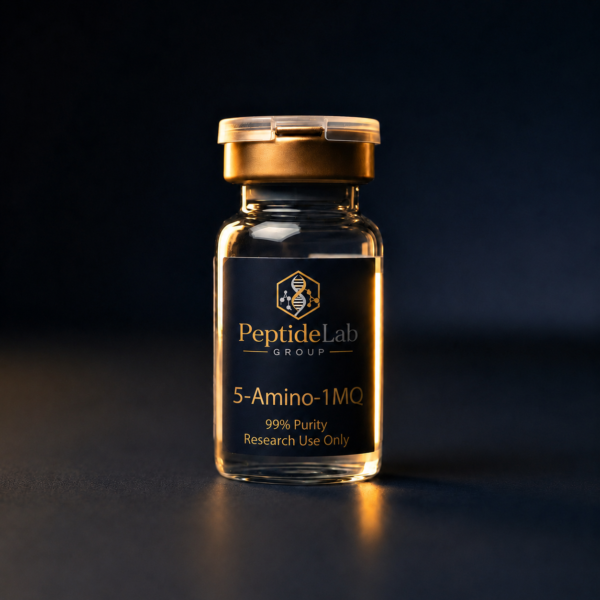
5-Amino-1MQ
$69.99
Research compound vial
- Description
Description
5-Amino-1MQ
5-Amino-1MQ from PeptideLab Group is presented as a premium branded metabolic research compound for laboratory and analytical research use only. This product is listed for qualified research customers and is not intended for human consumption. Each vial is prepared for clean catalog presentation with PeptideLab Group branding, research-use labeling, and product documentation details that can be added by the store owner where applicable.
Product Overview:
Brand: PeptideLab Group
Product: 5-Amino-1MQ
Category: Metabolic Research Peptides
Form: Research peptide / compound vial
Purity: Documentation available on request where applicable
Testing: COA, HPLC, and MS documentation available on request where applicable
Packaging: PeptideLab Group branded research vial
Stock Status: In stock
Research Category Information:
This product belongs to the metabolic research category, which includes compounds studied in laboratory settings for metabolic signaling, peptide pathway analysis, energy-balance models, receptor activity, and related biochemical research frameworks. It is supplied strictly for research use only and should be handled according to proper laboratory procedures.5-amino-1mq before and after
5-amino-1mq dosage subcutaneous
There is a critical need for new mechanism-of-action drugs that reduce the burden of obesity and associated chronic metabolic comorbidities. A potentially novel target to treat obesity and type 2 diabetes is nicotinamide-N-methyltransferase (NNMT), a cytosolic enzyme with newly identified roles in cellular metabolism and energy homeostasis. To validate NNMT as an anti-obesity drug target, we investigated the permeability, selectivity, mechanistic, and physiological properties of a series of small molecule NNMT inhibitors. Membrane permeability of NNMT inhibitors was characterized using parallel artificial membrane permeability and Caco-2 cell assays. Selectivity was tested against structurally-related methyltransferases and nicotinamide adenine dinucleotide (NAD+) salvage pathway enzymes. Effects of NNMT inhibitors on lipogenesis and intracellular levels of metabolites, including NNMT reaction product 1-methylnicotianamide (1-MNA) were evaluated in cultured adipocytes. Effects of a potent NNMT inhibitor on obesity measures and plasma lipid were assessed in diet-induced obese mice fed a high-fat diet. Methylquinolinium scaffolds with primary amine substitutions displayed high permeability from passive and active transport across membranes. Importantly, methylquinolinium analogues displayed high selectivity, not inhibiting related SAM-dependent methyltransferases or enzymes in the NAD+ salvage pathway. NNMT inhibitors reduced intracellular 1-MNA, increased intracellular NAD+ and S-(5′-adenosyl)-L-methionine (SAM), and suppressed lipogenesis in adipocytes. Treatment of diet-induced obese mice systemically with a potent NNMT inhibitor significantly reduced body weight and white adipose mass, decreased adipocyte size, and lowered plasma total cholesterol levels. Notably, administration of NNMT inhibitors did not impact total food intake nor produce any observable adverse effects. These results support development of small molecule NNMT inhibitors as therapeutics to reverse diet-induced obesity and validate NNMT as a viable target to treat obesity and related metabolic conditions. Increased flux of key cellular energy regulators, including NAD+ and SAM, may potentially define the therapeutic mechanism-of-action of NNMT inhibitors.5-amino-1mq side effects 5-amino-1mq dosage
Important Notice:
For laboratory research use only. Not for human consumption. Not intended to diagnose, treat, cure, or prevent any disease.
5-amino-1mq peptide
Using structure-guided design and binding calculations, we recently generated potent small molecule NNMT inhibitors around a methylquinolinium (MQ)-scaffold.] In the present study, we extend these findings to show that the small molecule NNMT inhibitors are highly membrane-permeable, selective inhibitors, which reduce intracellular 1-MNA levels and prevent lipogenesis in vitro. These amenable properties demonstrated for the small molecules led us to conduct a proof-of-concept in vivo study in diet-induced obese mice to test the hypothesis that the most potent inhibitor when administered systemically, would reverse obesity by causing substantial loss of body weight and adiposity without causing any observable adverse effects.5-amino-1mq dosage per day
Related Products