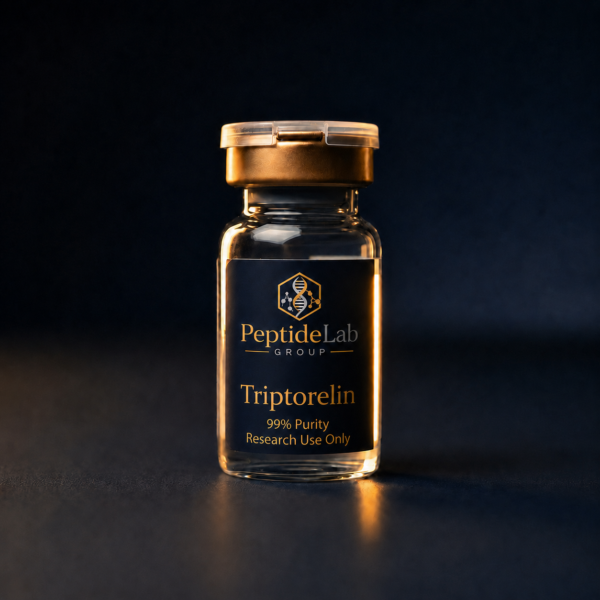
Triptorelin
$74.99
Research peptide vial
Triptorelin is administered to patients in the form of acetate or pamoate (also known as embonate) salts, and in response to the need for ADT regimens that improve convenience and treatment adherence, sustained-release 1-month (3 or 3.75 mg), 3-month (11.25 mg), and 6-month (22.5 mg) formulations of triptorelin have been developed . Sustained-release formulations of triptorelin comprise microparticles of the decapeptide incorporated within a biocompatible and biodegradable copolymer (polylactide-co-glycolide)
- Description
Description
Triptorelin
Product Overview
Triptorelin from PeptideLab Group is presented as a premium research peptide vial for laboratory and analytical research use only. This product is listed in the Hormonal Support Peptides category for research buyers focused on endocrine pathway models and peptide-related hormone signaling studies.
The page is built for a research-use-only catalog structure and should not be positioned with human-use, clinical, medical, treatment, or dosage claims.
Prostate cancer is the most frequently occurring cancer among European men, with an estimated incidence of 416,700 (varying from 25 to 193 per 100,000 populations in different European countries) and an estimated 92,200 deaths in 2012 . In the USA, incidence of prostate cancer is within this European range at 138 per 100,000 populations according to the Surveillance, Epidemiology, and End Result program . Hereditary factors are important for determining the risk of developing prostate cancer and exogenous factors may have an impact on the risk of progression. However, in general, the risk factors for prostate cancer are poorly understood and consequent advice on prevention is not possible . Therefore, the management of prostate cancer focuses on treating the disease, and the hormone dependence of prostate cancer has been recognized for decades [4]. As a consequence, testosterone suppression has been the standard palliative treatment in men with advanced prostate cancer for many years. Orchiectomy is a simple, low-cost surgical procedure that effectively and quickly achieves castration, but because it is irreversible and does not allow intermittent treatment, it has become less popular than hormonal therapies among patients.
The selection of appropriate treatment is mainly dependent on the stage of disease and the risk of progression. Prostate cancer is generally described as localized, locally advanced (when the tumor has extended beyond the capsule of the prostate) and metastatic disease, and is classified using the Tumor-lymph Nodes-Metastasis (TNM) system . Patients are also categorized into low, high, or intermediate risk of progression according to clinical stage, Gleason score, and prostate-specific antigen (PSA) level and this will continue with the adoption of the recent International Society of Urological Pathology (ISUP) modified Gleason grading patterns . However, a recent assessment of a large cohort found that while high levels of PSA (>100 ng/ml) at diagnosis were associated with a reduction in survival after 5 and 10 years, within this high-risk group PSA level was not associated with prostate cancer-specific mortality . Gleason score and the presence of metastasis were the strongest predictors of prostate cancer-specific mortality in this group with high PSA at presentation . What is clear is that patients classified as having low or intermediate risk prostate cancer (Gleason score <8 and PSA <20 ng/ml) may have a 10-year prostate cancer-specific mortality of <5%, and avoiding unnecessary treatment is a challenge in these patients . Patients with high-risk prostate cancer make up a considerable proportion of newly diagnosed patients and have much higher mortality rates, and therefore, the challenge in these men is to increase overall survival while reducing any adverse effects of treatment. However, this high-risk population is heterogeneous and more information is needed on the validity of suggested prognostic indicators, such as the number and location of bone metastases, visceral metastases, Gleason score, and the initial PSA level
Product Details
- Brand: PeptideLab Group
- Product: Triptorelin
- Category: Hormonal Support Peptides
- Form: Lyophilized research peptide vial
- Use: Laboratory research use only
- Packaging: PeptideLab Group branded vial
- Documentation: COA, HPLC, and MS documentation may be available where applicable
Quality & Handling
PeptideLab Group structures product listings for clear catalog presentation, professional buyer experience, and documentation-ready research supply organization.
Research Use Notice
This product is intended strictly for laboratory research use only. It is not intended for human consumption, veterinary use, medical use, diagnosis, treatment, cure, or prevention of disease. Buyers are responsible for understanding and following all applicable laws and regulations in their jurisdiction.
Androgen deprivation therapy (ADT) is the mainstay palliative treatment for men with locally advanced and metastatic prostate cancer, and aims to reduce testosterone to levels obtained by surgical castration. Use of gonadotropin-releasing hormone (GnRH) agonists predominates among the ADT options. The GnRH agonist, triptorelin is a first-line hormonal therapy that has demonstrated efficacy and safety in clinical trials of patients with locally advanced non-metastatic or metastatic disease. Sustained-release 1-, 3- and 6-month formulations of triptorelin, administered intramuscularly or subcutaneously, have been developed to provide improved flexibility and convenience for the patient. Head-to-head studies of GnRH agonists are lacking in the field of prostate cancer. Despite the inevitable progression to castration-resistant prostate cancer (CRPC) in most patients receiving ADT, monitoring of testosterone levels needs to improve in routine practice and physicians should not overlook the benefits of continued ADT in their patients when introducing one of the various new treatment options for CRPC. For improved survival outcomes, there remains a need to tailor ADT treatment regimens, novel hormonal agents and chemotherapy according to the individual patient with advanced prostate cancer.
Related Products