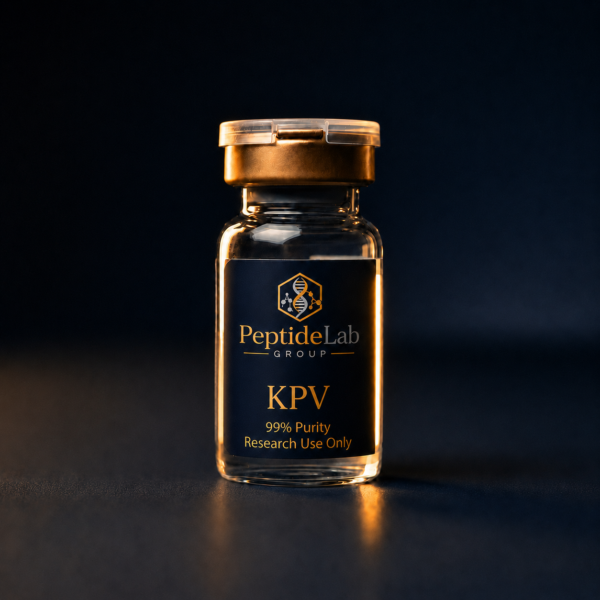
KPV
$54.99
Research peptide vial
KPV is a tripeptide (Lys-Pro-Val) which possesses anti-inflammatory properties however its mechanisms of action still remain unknown. PepT1 is a di/tripeptide transporter normally expressed in the small intestine and induced in colon during inflammatory bowel disease (IBD). The aim of this study was to 1) investigate whether KPV anti-inflammatory effect is PepT1-mediated in intestinal epithelial and immune cells, and 2) examine KPV anti-inflammatory effect in two models of mice colitis.
- Description
Description
kpv
Product Overview
KPV from PeptideLab Group is presented as a premium research peptide vial for laboratory and analytical research use only. This product is positioned under immune support research for peptide pathway, inflammatory signaling, and cellular response research catalog organization.
KPV may also appear in recovery-related research categories, but on PeptideLab Group it can be organized under immune support research when the product page is focused on immune pathway and cellular-response study contexts.
We therefore investigated whether KPV can be transported by hPepT1 into Caco2-BBE cells. We first assessed the inhibitory effect of KPV vs Gly-Leu on hPepT1-mediated transport of [14C]Glycine-Sarcosine (Gly-Sar) which is a commonly used hPepT1 substrate. One hundred μM KPV inhibited [14C]Gly-Sar uptake more efficiently than 100 μM Gly-Leu (~45% inhibition by KPV vs ~25% by Gly-Leu) . This indicates that hPepT1 has a higher affinity for KPV than for Gly-Leu. To further confirm that hPepT1 transports KPV, uptake experiments were performed using [3H]KPV. We show that, in contrast to [14C]Gly-Sar, nanomolar concentrations of [3H]KPV were efficiently transported by hPepT1 . These results were confirmed by kinetic experiments showing that hPepT1 had a low Km of ~160 μM for KPV
Product Details
- Brand: PeptideLab Group
- Product: KPV
- Category: Immune Support Research Peptides
- Form: Lyophilized research peptide vial
- Use: Laboratory research use only
- Packaging: PeptideLab Group branded vial
- Documentation: COA, HPLC, and MS documentation may be available where applicable
Quality & Handling
This product listing is designed for a clean WooCommerce catalog experience with product information, documentation support wording, and research-use-only presentation. Bulk supply or sourcing questions can be handled through PeptideLab Group support.
Research Use Notice
This product is intended strictly for laboratory research use only. It is not intended for human consumption, veterinary use, medical use, diagnosis, treatment, cure, or prevention of disease. Buyers are responsible for complying with all laws and regulations in their jurisdiction.
Human intestinal epithelial cells (Caco2-BBE and HT29-Cl.19A), and human T cells (Jurkat) were stimulated with pro-inflammatory cytokines in the presence or absence of KPV. KPV anti-inflammatory effect was assessed using a NF-κB luciferase gene reporter, western blot, real-time RT-PCR and ELISA. Uptake experiments were performed using cold KPV as a competitor for hPepT1 radiolabelled substrate or using [3H]KPV to determine kinetic characteristics of KPV uptake. Anti-inflammatory effect of KPV was also investigated in DSS- and TNBS-induced colitis in mice. KPV was added to drinking water and inflammation was assessed at the histological level and by pro-inflammatory cytokine mRNA expression.
It is known that MAPK and NF-κB pathways activation in IEC induces the production of pro-inflammatory cytokines that have a role in the recruitment of immune cells such as IL-8 . To examine whether KPV affects IL-8 expression and secretion by Caco2-BBE cells, IL-8 mRNA and protein levels were assessed by real-time RT-PCR and ELISA. We found that IL-1β induced a ~200-fold increase of IL-8 mRNA after 3 hours of stimulation in comparison with untreated cells . In the presence of KPV, however, the IL-1β-induced increase of IL-8 mRNA was significantly reduced (by ~35%) . Correlatively, the increase of IL-8 concentration in the culture medium of Caco2-BBE cells treated with IL-1β for 3 or 5 hours was significantly decreased by co-incubation with KPV
Related Products