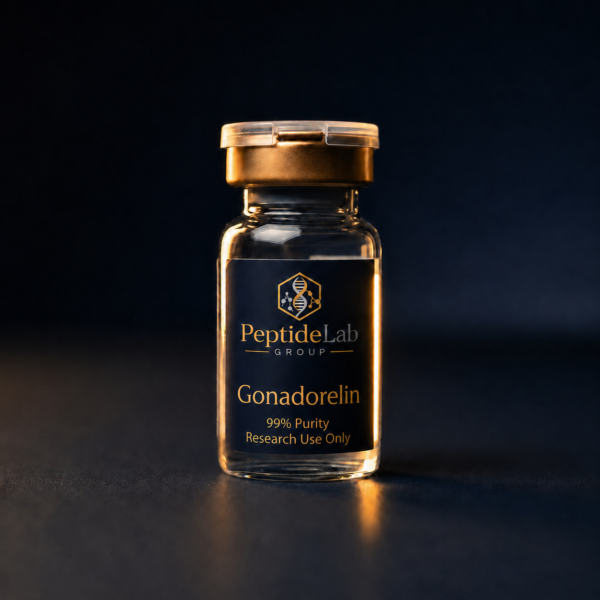
Gonadorelin
$59.99
Research peptide vial
Gonadorelin is a medicine that is the same as gonadotropin-releasing hormone (GnRH) that is naturally released from the hypothalamus gland. GnRH causes the pituitary gland to release other hormones (luteinizing hormone [LH] and follicle-stimulating hormone [FSH]). LH and FSH control development in children and fertility in adults.
Gonadorelin is used to test how well the hypothalamus and the pituitary glands are working. It is also used to cause ovulation (release of an egg from the ovary) in women who do not have regular ovulation and menstrual periods because the hypothalamus gland does not release enough GnRH.
Gonadorelin may also be used for other conditions as determined by your doctor.
- Description
Description
gonadorelin
Product Overview
Gonadorelin from PeptideLab Group is presented as a premium research peptide vial for laboratory and analytical research use only. This product is included in the Hormonal Support Peptides category for catalog organization around endocrine signaling, peptide pathway research, and hormone-related laboratory studies.
The product page is written for a research-focused WooCommerce store and avoids human-use, medical, dosing, therapeutic, or outcome-based claims.
Product Details
- Brand: PeptideLab Group
- Product: Gonadorelin
- Category: Hormonal Support Peptides
- Form: Lyophilized research peptide vial
- Use: Laboratory research use only
- Packaging: PeptideLab Group branded vial
- Documentation: COA, HPLC, and MS documentation may be available where applicable
Quality & Handling
PeptideLab Group product listings are designed to provide clean product information, organized categories, and research-use-only compliance wording for professional catalog presentation.
Research Use Notice
This product is intended strictly for laboratory research use only. It is not intended for human consumption, veterinary use, medical use, diagnosis, treatment, cure, or prevention of disease. Buyers are responsible for understanding and following all applicable laws and regulations in their jurisdiction.
Although certain medicines should not be used together at all, in other cases two different medicines may be used together even if an interaction might occur. In these cases, your doctor may want to change the dose, or other precautions may be necessary. When you are taking this medicine, it is especially important that your healthcare professional know if you are taking any of the medicines listed below. The following interactions have been selected on the basis of their potential significance and are not necessarily all-inclusive.
Using this medicine with any of the following medicines is not recommended. Your doctor may decide not to treat you with this medication or change some of the other medicines you take.
- Bepridil
- Cisapride
- Dronedarone
- Levoketoconazole
- Mesoridazine
- Pimozide
- Piperaquine
- Saquinavir
- Sparfloxacin
- Terfenadine
- Thioridazine
- Ziprasidone
Using this medicine with any of the following medicines is usually not recommended, but may be required in some cases. If both medicines are prescribed together, your doctor may change the dose or how often you use one or both of the medicines.
If you are having a test done with gonadorelin, one or more samples of your blood will be taken. Then gonadorelin is given by an intravenous (into a vein) or a subcutaneous (under the skin) injection. At regular times after the medicine is given, more blood samples will be taken. Then the results of the test will be studied.
Some medicines given by injection or by injection pump may sometimes be given at home to patients who do not need to be in the hospital. If you are using this medicine at home, make sure you clearly understand and carefully follow your doctor’s instructions.
Dosing
The dose of this medicine will be different for different patients. Follow your doctor’s orders or the directions on the label. The following information includes only the average doses of this medicine. If your dose is different, do not change it unless your doctor tells you to do so.
The amount of medicine that you take depends on the strength of the medicine. Also, the number of doses you take each day, the time allowed between doses, and the length of time you take the medicine depend on the medical problem for which you are using the medicine.
- For injection dosage form (for Lutrepulse pump):
- For treating amenorrhea or infertility in women caused by pituitary or hypothalamus problems:
- Adults—5 microgram (mcg) injected by the pump into a vein or under the skin slowly over 1 minute, every ninety minutes for twenty-one days. As determined by doctor, dose may be changed slowly, decreased to 1 mcg or increased to 20 mcg if needed.
- Children up to 18 years of age—Use and dose must be determined by the doctor.
- For treating amenorrhea or infertility in women caused by pituitary or hypothalamus problems:
- For injection dosage form (single-dose injection):
- For testing the hypothalamus and pituitary glands:
- Adults—0.1 milligram (mg) injected once as a single dose under the skin or into a vein.
- Children 12 years of age and older—2 micrograms (mcg) per kilogram (kg) (0.9 mcg per pound) of body weight, not to exceed a single dose of 100 mcg, injected once under the skin or into vein.
- Children up to 12 years of age—Use and dose must be determined by doctor.
- For testing the hypothalamus and pituitary glands: